
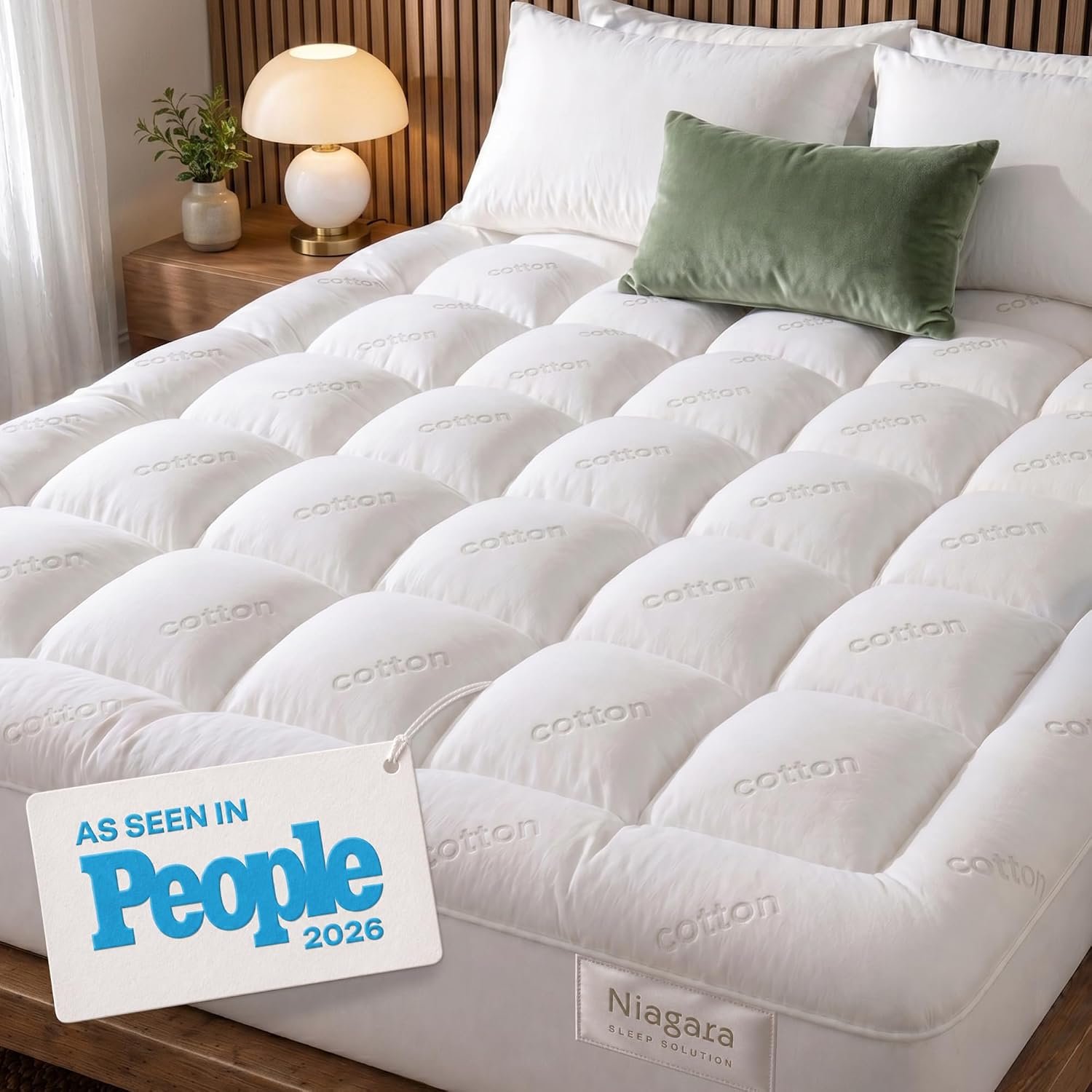
Niagara Sleep Solution Cloud-Like Queen Mattress Topper: A Cotton-Top Layer for Hot Sleepers
The Niagara Sleep Solution Cloud-Like Queen Non-Slip Mattress Topper places a 100% cotton top layer over an existing mattress, with a plush firmness rating designed to soften worn or overly firm sleep surfaces without requiring a full mattress replacement. This Niagara Sleep Solution Cloud review examines how the topper’s cotton face, polyester underside, and deep-pocket skirt work together to add cushioning, manage heat, and stay anchored on mattresses ranging from 8 to 20 inches deep. Because the construction relies on natural cotton fiber rather than latex or memory foam, it is positioned for sleepers who prioritize breathability and a lightweight, machine-washable topper over the denser contouring associated with foam-based options.
The intended sleeper profile skews toward back and side sleepers seeking incremental pressure relief on an already-supportive base mattress, as well as hot sleepers who find foam toppers trap warmth. Households with sensitive skin or chemical sensitivities may also gravitate toward the product’s stated absence of latex or formaldehyde-based materials. Because the topper is a surface layer rather than a structural support system, its role is best understood as a comfort enhancement rather than a fix for a mattress that has lost its underlying support.
Quick Overview
| Feature | Details |
|---|---|
| Product Type | Mattress topper (surface comfort layer) |
| Firmness Level | Plush |
| Size | Queen (60 x 80 inches) |
| Compatible Mattress Depth | 8 to 20 inches, deep-pocket fit |
| Top Fabric | 100% Cotton |
| Bottom Fabric | 100% Polyester |
| Skirt Material | 100% Polyester, elastic stretch sides |
| Thread Count | 300 |
| Special Features | Breathable, cooling, deep pocket, noiseless, washable |
| Closure Type | Pull-on |
| Water Resistance | Not water resistant |
| Care Instructions | Machine washable |
| Aggregated Customer Rating | 4.4 out of 5 across roughly 3,900 ratings |
These specifications point to a lightweight, breathable comfort layer rather than a dense contouring pad. The plush firmness and all-cotton top suit sleepers who want a softer, cooler surface and are willing to accept less pressure-cupping contour than latex or memory foam provides. The 8-to-20-inch pocket depth and elastic skirt are intended to accommodate a range of mattress profiles, including taller pillow-top and hybrid constructions, while the machine-washable design supports routine maintenance for households prioritizing hygiene and ease of care.

Firmness, Feel, and Sleeping Position Suitability
The manufacturer lists the topper’s firmness as plush, which generally translates to a soft, yielding surface that sits on top of the underlying mattress rather than replacing its support structure. This firmness profile tends to suit side sleepers who need cushioning at the shoulders and hips, as well as back sleepers who want a slightly softer feel without sacrificing the firmness of the base mattress beneath. Stomach sleepers, who typically require firmer, flatter surfaces to prevent the hips from sinking and the spine from arching, may find a plush cotton topper less suited to their needs unless the underlying mattress is already on the firmer side. Because the topper does not contain foam or latex, its plush feel comes primarily from the loft of the cotton fill rather than from deep contouring.

Side Sleepers
Side sleepers place concentrated pressure on the shoulders and hips, and a plush cotton topper can soften those contact points relative to sleeping directly on a firmer mattress surface. Because cotton fill compresses under weight without the slower recovery associated with memory foam, side sleepers may notice a responsive, less “hugging” sensation compared to viscoelastic toppers. This can benefit sleepers who dislike the sinking feeling of memory foam while still wanting extra cushioning at pressure points.
The 300 thread count top fabric also plays a role in how the surface feels under a side sleeper’s shoulder and hip, since a tighter weave typically feels smoother and less prone to pilling than lower thread count cotton blends. Side sleepers switching from a firmer mattress to this topper may notice the most immediate difference in shoulder pressure, since that contact point tends to carry the greatest concentrated body weight in this sleeping position.
Back and Stomach Sleepers
Back sleepers generally benefit from the added plushness at the lumbar region, provided the base mattress still delivers adequate spinal support underneath the topper. Stomach sleepers, however, typically need firmer surfaces, and a plush cotton layer could allow the midsection to sink slightly more than ideal on an already soft mattress, a consideration worth weighing against sleeping position preferences and existing mattress firmness.
Combination sleepers who shift between back and side positions throughout the night may find the plush cotton surface accommodating in both orientations, since the topper does not lock the body into a single contour the way slower-recovery foam can. This flexibility is one advantage of a fiber-fill construction over deep-contouring alternatives for sleepers who move frequently.
Temperature Regulation and Cooling Performance
Temperature regulation is one of the more emphasized characteristics of this topper, driven primarily by its 100% cotton top fabric and the manufacturer’s breathable and cooling designations. Cotton is a natural fiber known for moisture-wicking and airflow properties, which allows heat and perspiration to dissipate more readily than with dense synthetic foams. For hot sleepers who have previously used memory foam toppers and experienced heat retention, a cotton-topped alternative can represent a meaningful shift in how warm the sleep surface feels throughout the night. This cooling behavior is a construction-driven characteristic rather than a marketed gel or phase-change technology, relying instead on the inherent breathability of natural cotton fiber and the topper’s relatively low-loft profile, which avoids the thick, insulating layers that trap body heat in denser foam products.

Cotton Construction and Airflow
Because the top layer is spun from cotton rather than a closed-cell foam, air can move more freely through the fabric structure, reducing the insulating effect that dense foams often create. This construction-based breathability tends to benefit sleepers in warmer climates or those who run hot overnight, since heat is less likely to become trapped between the body and the mattress surface.
The polyester underside and skirt do not carry the same breathability as the cotton face, so most of the topper’s cooling behavior is concentrated at the sleep surface itself rather than throughout the full construction. This layered approach keeps manufacturing costs practical while directing the breathable material to where body contact actually occurs.
Comparison to Latex and Foam Alternatives
Shoppers comparing cooling toppers sometimes weigh a cotton option against a dunlop latex mattress or a natural latex single mattress, both of which offer their own breathability through an open-cell structure but typically at a firmer feel and higher density. A cotton topper like this one trades some of latex’s durability and contouring for a lighter, more washable surface that some hot sleepers may find cooler to the touch in the short term.
Memory foam toppers, by contrast, are frequently cited in customer feedback across the category for retaining heat due to their dense, slow-recovery cell structure. A cotton-topped design sidesteps that specific complaint, though it does so by sacrificing the deeper body contouring that foam and latex mattresses, including a latex mattress single option, are generally chosen for.
Pressure Relief and Spinal Alignment
Pressure relief from this topper functions primarily as a cushioning buffer rather than a deep-contouring support system, since cotton fill does not conform to body curves the way memory foam or latex does. The plush surface can reduce the sensation of a firm or aging mattress pressing directly against the shoulders, hips, and lower back, which is one of the reasons the listing positions the product as a back pain relief accessory. Spinal alignment, however, depends heavily on the mattress beneath the topper maintaining adequate support; a topper alone cannot correct sagging or an unsupportive base. For sleepers whose mattress has become uncomfortably firm with age but still holds its structural integrity, adding this plush layer may ease pressure points without altering the underlying alignment the mattress already provides.

Easing Pressure on an Aging or Firm Mattress
Older mattresses can lose surface softness even while retaining core support, and a plush cotton topper is designed to restore some of that surface give. This can translate into reduced pressure at the shoulders and hips for side sleepers, particularly on mattresses that have become firmer than intended over years of use.
This effect is most noticeable on mattresses that are structurally sound but have simply hardened with age, a common outcome for foam and hybrid mattresses several years into their lifespan. Adding a plush layer in this scenario addresses the surface feel without requiring a full mattress purchase.
Limits of Surface-Level Cushioning
Because the topper adds cushioning rather than structural support, it is not positioned to compensate for a mattress with sagging, broken coils, or worn-out foam layers. Sleepers dealing with persistent back discomfort tied to an unsupportive mattress may need to address the base mattress itself rather than relying solely on a topper.
A topper of this type also cannot correct alignment issues caused by an incorrect firmness match for a given body type or sleeping position, since its role is limited to the top few inches of the sleep surface rather than the support core beneath it.
Fit, Construction, and Motion Response
Fit and construction details matter for a queen topper intended to stay in place across mattresses of varying heights, and this model addresses that with a deep-pocket, elastic skirt rated for mattresses between 8 and 20 inches deep. The pull-on design and stretchy sides are intended to accommodate pillow-top and hybrid mattresses without slipping loose during normal movement, which is a common complaint with shallower or non-elasticized topper skirts. Motion isolation is a secondary consideration for cotton toppers, since the material lacks the slow-recovery dampening properties of memory foam; movement transfer is likely to feel closer to sleeping on the base mattress itself, with the topper primarily softening contact points rather than absorbing motion energy. For couples sharing a queen mattress, this means the topper’s contribution to reducing partner disturbance will be modest compared to viscoelastic alternatives.

Deep-Pocket, Non-Slip Design
The elastic skirt and deep-pocket sizing are engineered to grip mattresses up to 20 inches deep, which should reduce the bunching or shifting that can occur with toppers designed for shallower profiles. This is particularly relevant for pillow-top or hybrid mattresses where uneven surfaces can otherwise cause a thinner topper to slide.
The pull-on closure type simplifies setup, since the topper stretches over the mattress corners rather than requiring separate straps or ties. This design detail matters most during initial setup and whenever the topper is removed for washing and then repositioned.
Motion Transfer and Noise
Because cotton does not exhibit the same viscoelastic response as memory foam, motion transfer across the topper is likely to feel more similar to the base mattress than a foam layer would provide. The manufacturer’s noiseless designation suggests the construction avoids the crinkling sounds sometimes associated with waterproof or vinyl-backed toppers.
Couples sharing a queen-size bed who are sensitive to nighttime movement may still feel a partner shifting position, since the topper’s fiber fill does not absorb motion energy the way slower-recovery foam does. This is a tradeoff against the breathability and washability the cotton construction provides.
Durability, Maintenance, and Long-Term Wear
Durability expectations for cotton toppers generally differ from latex or foam constructions, since natural fiber fill tends to compress and flatten with repeated use more readily than latex, which is prized for its resilience and slower breakdown over time. Compared to something like a dunlop latex mattress topper, a cotton fill product may show loft loss sooner, though the 300 thread count top fabric and polyester backing are intended to support routine handling. A meaningful advantage of this construction is machine washability, which allows the topper to be laundered and refreshed rather than requiring spot cleaning or replacement at the first sign of soiling. Aggregated customer feedback reflected in the product’s 4.4 rating across roughly 3,900 reviews suggests general satisfaction with comfort and cooling, though long-term loft retention over multiple years is not detailed in the manufacturer’s published specifications.

Machine-Washable Care
The ability to machine wash and dry the topper differentiates it from foam-based alternatives, which typically cannot be fully submerged without damaging their cellular structure. Households prioritizing hygiene, allergy management, or households with pets and children may value this washable design as a practical long-term maintenance advantage.
Regular washing can also help the cotton fill regain some loft between cycles, since fiber-based fill tends to fluff back up after laundering in a way that foam cannot replicate once compressed. This makes routine care more directly tied to the topper’s perceived comfort over time than with non-washable alternatives.
Expected Fiber Compression Over Time
As with most cotton-fill toppers, some flattening of loft can be expected with sustained nightly use, a characteristic shared across most fiber-filled bedding products rather than a defect specific to this model. Sleepers seeking a topper with slower long-term compression may want to compare cotton fill against denser latex single mattress toppers, which generally hold their shape longer under consistent body weight.
Shoppers weighing this tradeoff sometimes research a pure comfort latex mattress price point as a longer-term alternative, since latex fill is widely regarded for resisting compression set over years of nightly use in a way that natural fiber fill typically cannot match.

Pros & Cons
Pros
- The 100% cotton top fabric offers natural breathability that can help reduce heat buildup compared to dense memory foam toppers, benefiting sleepers who tend to run warm overnight.
- The plush firmness adds a cushioned layer over firm or aging mattresses, which may ease pressure at the shoulders and hips for side and back sleepers.
- The deep-pocket, elastic-skirt design is rated for mattresses between 8 and 20 inches deep, reducing the likelihood of slipping on pillow-top or hybrid mattress profiles.
- Machine washability allows for straightforward maintenance and refreshing, an advantage over foam or latex toppers that cannot be laundered.
- The listing states the product avoids latex and formaldehyde-based materials, which may appeal to sleepers with material sensitivities.
- The noiseless construction avoids the crinkling sounds sometimes associated with vinyl-backed or waterproof topper linings.
- A 4.4 aggregated rating across roughly 3,900 customer reviews suggests broadly favorable feedback on comfort and cooling performance.
- The pull-on, non-slip design is intended to simplify setup compared to toppers requiring separate fasteners or straps.
Cons
- Cotton fill generally does not contour to the body the way memory foam or latex does, so pressure relief is more surface-level cushioning than deep conforming support.
- The topper is not water resistant, which may be a drawback for households managing spills, pets, or young children compared to protected alternatives.
- Fiber-filled cotton toppers tend to compress and lose loft faster over time than denser natural latex options prized for slower long-term breakdown.
- Motion isolation is limited relative to memory foam, so couples seeking maximum disturbance reduction may find the cotton construction less effective.
- As a comfort layer only, the topper cannot correct structural issues like sagging or broken support in the underlying mattress.
Final Verdict: Who This Mattress Topper Is Best For (and Who Should Skip It)
The Niagara Sleep Solution Cloud-Like Queen Mattress Topper is best suited to side and back sleepers who want a breathable, plush cushioning layer over a mattress that has become uncomfortably firm but still provides adequate underlying support. Hot sleepers who have struggled with heat retention on memory foam toppers may find the cotton top’s natural airflow a practical improvement, and the machine-washable design adds a maintenance advantage for households prioritizing hygiene. The deep-pocket, non-slip skirt makes it a reasonable fit for taller pillow-top or hybrid mattresses within the 8-to-20-inch depth range.
Sleepers who need deep contouring pressure relief, such as those managing significant joint discomfort, may find cotton fill less effective than memory foam or latex constructions like a natural latex single mattress topper, which typically offers more durable, body-conforming support. Stomach sleepers and those needing firmer sleep surfaces should also weigh the plush rating carefully, since additional softness can work against proper alignment on already soft mattresses. Compared to other 2026 topper options built around latex or gel-infused foam, this product’s core strengths remain breathability, washability, and ease of fit rather than long-term contouring durability.

Frequently Asked Questions (FAQs)
Is the Niagara Sleep Solution Cloud-Like mattress topper good for hot sleepers?
The topper’s 100% cotton top fabric is designed to be breathable and moisture-wicking, which generally helps dissipate heat more effectively than dense memory foam. Because the construction avoids thick synthetic foam layers, air can circulate more freely near the sleep surface. Hot sleepers who have experienced heat retention with foam toppers may find the cotton design a more temperature-neutral alternative, though individual results can vary with room climate and bedding.
What firmness level does the Niagara Sleep Solution cotton mattress topper have?
The manufacturer lists the firmness as plush, meaning the topper is designed to feel soft and cushioned rather than dense or supportive on its own. This firmness level is intended to add a gentle layer of give over an existing mattress rather than change its underlying support structure. Sleepers who prefer a softer surface, particularly side and back sleepers, are the most likely to find this firmness level suitable.
Will this mattress topper fit a thick pillow-top or hybrid mattress?
The topper is designed with a deep-pocket, elastic skirt rated to accommodate mattresses between 8 and 20 inches deep, which covers most standard, pillow-top, and hybrid mattress profiles. The stretchy sides are intended to keep the topper anchored in place rather than shifting during normal use. Sleepers with mattresses taller than 20 inches should confirm compatibility before purchase, since the listed range represents the manufacturer’s stated limit.
Can the Niagara Sleep Solution mattress topper be machine washed?
Yes, the product is listed as machine washable, which distinguishes it from foam or latex toppers that typically require spot cleaning only. This allows the cotton fill to be laundered periodically for hygiene purposes, and washing can also help restore some loft to the fiber fill over time. Manufacturer care instructions should be followed to avoid excessive shrinkage or wear during drying cycles.
Is a cotton mattress topper better than a dunlop latex mattress topper for cooling?
Cotton and latex both offer natural breathability compared to dense memory foam, though the two materials achieve cooling differently. A dunlop latex mattress relies on an open-cell structure and higher density, while a cotton topper achieves airflow through its woven fiber construction and lighter loft. Cotton may feel cooler to the touch initially, while latex generally offers more consistent long-term breathability alongside greater durability.
How does this cotton topper compare to a zenna latex mattress review in terms of pressure relief?
Reviews of latex mattress products, including a zenna latex mattress review, typically emphasize deeper body contouring and consistent pressure distribution due to latex’s denser, more elastic structure. A cotton topper like this one provides surface-level cushioning rather than deep contouring, making it a lighter comfort addition rather than a substitute for the structured pressure relief that latex constructions are generally recognized for.
Does this mattress topper help with back pain?
The listing positions the topper as a back pain relief accessory by adding a plush cushioning layer over a firm or aging mattress surface, which can reduce pressure at contact points like the shoulders and hips. However, the topper cannot correct structural issues such as sagging or inadequate support in the base mattress, so its effect on back discomfort depends heavily on the condition of the mattress underneath.
Is this topper suitable for stomach sleepers?
Stomach sleepers generally benefit from firmer, flatter sleep surfaces that prevent the hips from sinking too deeply, so a plush cotton topper may not be the ideal match unless the base mattress is already fairly firm. On a firmer mattress, the added plushness may feel comfortable, but on a softer mattress it could increase sinkage in ways that stomach sleepers typically want to avoid.