
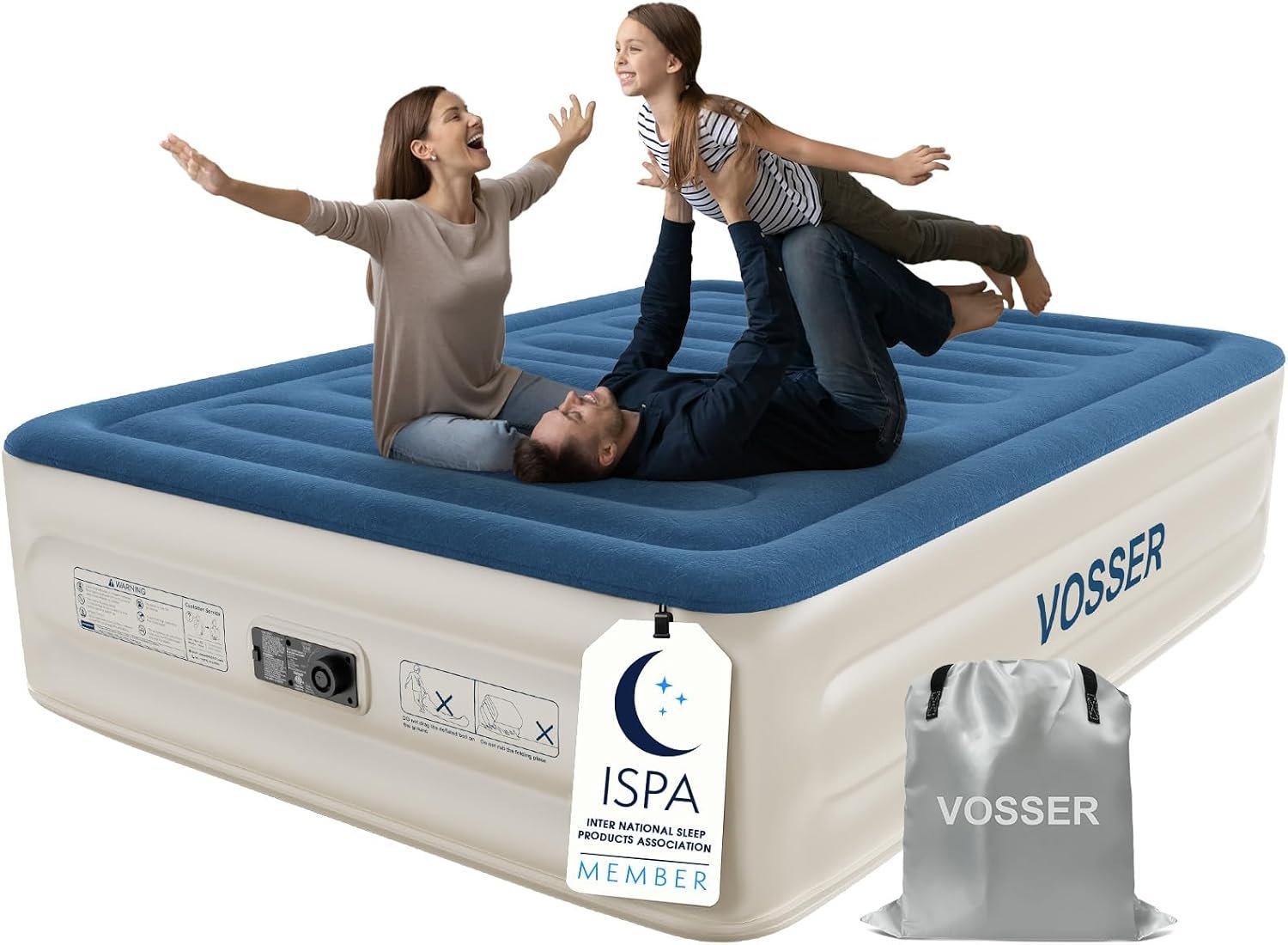
VOSSER Queen Air Mattress with Built-In Pump: 18-Inch I-Beam Design Overview
The VOSSER Queen Air Mattress with Built-In Pump, a review-worthy entry in the raised air bed category, is built around a patented I-Beam internal structure and an 18-inch double-high profile designed to replicate the feel of a traditional bed frame rather than a typical camping pad. Its flocked top layer, extra-thick PVC shell, and integrated 110V pump position it toward buyers who need a temporary or occasional sleeping surface that still delivers a stable, supportive feel night after night. Because the mattress sits considerably taller than most inflatable beds, it is aimed squarely at guest rooms, home offices that convert into sleeping spaces, and campers who want to avoid getting in and out of a bed at floor level. Couples, seniors, and anyone hosting overnight visitors form the core intended sleeper profile, since the raised height reduces strain when sitting down or standing up. The firm, air-coil construction and 660-pound weight capacity also suggest a product engineered for two adults sharing the surface rather than a single lightweight user. The sections below break down firmness, pressure relief, temperature behavior, motion isolation, and long-term durability so prospective buyers can judge fit before purchase.
Quick Overview
| Feature | Details |
|---|---|
| Mattress Type | Raised air/inflatable bed with built-in electric pump |
| Firmness Level | Firm (manufacturer-listed) |
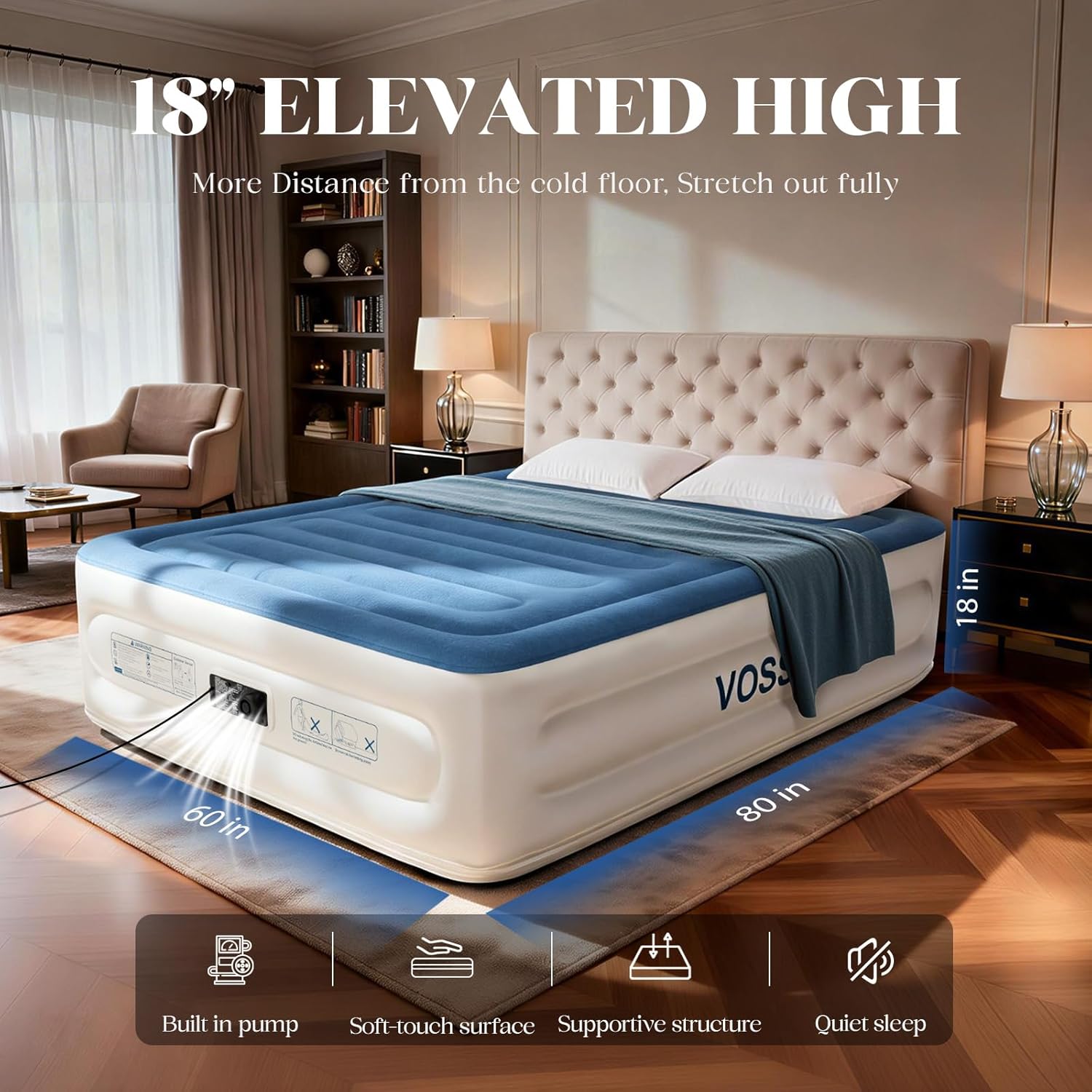
| Height / Profile | 18 inches, double-high raised design |
| Dimensions | 80″L x 60″W x 18″Th (Queen) |
| Top Material | Flocked polyester-blend surface |
| Core Material | Extra-thick Polyvinyl Chloride (PVC), I-Beam internal coils |
| Weight Capacity | 660 pounds |
| Included Components | Air mattress, carry bag, repair patch, user guide |
| Best Suited Sleepers | Couples, families, overnight guests, campers |
| Intended Use Cases | Home guest rooms, indoor and outdoor use, travel |
| Support Coverage | 10-year manufacturer support |
These specifications point to a mattress built for occasional-to-regular use rather than nightly, long-term primary sleeping. The firm feel, reinforced PVC shell, and 660-pound capacity suit couples and heavier sleepers who need stable support, while the 18-inch height and included storage bag serve guest-room and travel scenarios where quick setup and easy entry matter more than plush cushioning.
Firmness, Feel, and Sleeping Position Suitability
The VOSSER Queen Air Mattress with Built-In Pump is listed with a firm feel, a characteristic typical of air-coil inflatable beds where internal air pressure, rather than foam density, determines surface give. Firm air surfaces tend to favor back and stomach sleepers who benefit from a level plane that resists excessive sinkage at the hips, while side sleepers may notice more pressure at the shoulder and hip unless the internal pressure is dialed down slightly using the rotary pump dial. Because the rotary control allows incremental adjustment rather than an all-or-nothing inflate cycle, sleepers have some ability to soften the surface within the limits of the air-coil structure. This adjustability is a meaningful differentiator from single-chamber air beds that only offer maximum-firm or under-inflated extremes.

Back and Stomach Sleepers
Back and stomach sleepers generally fare well on firmer air mattresses because these positions require a level surface that keeps the lumbar spine from arching or the hips from sinking too deeply into the material. The I-Beam construction reinforces this flatness by resisting the natural tendency of air chambers to bow outward under load, which helps maintain consistent support across the torso and hip region for the duration of the night.
For stomach sleepers in particular, an overly soft surface can allow the midsection to dip while the chest and hips remain elevated, creating strain across the lower back. Because the internal coil structure holds its shape rather than compressing unevenly, the mattress is positioned to keep this group closer to a neutral spinal line than a standard single-chamber air bed would, though the firm baseline means little cushioning is added beyond what the flocked top layer provides.
Side Sleepers and Pressure Points
Side sleepers place more concentrated weight on the shoulder and hip, areas that respond better to some surface give. On a firm air-coil mattress, side sleepers may want to reduce inflation slightly below maximum firmness to allow a small amount of shoulder sink-in, since a fully firm surface without a plush topper can create noticeable pressure at these contact points during extended use.
The rotary dial pump offers a practical workaround, since it allows incremental deflation rather than an all-or-nothing setting. Side sleepers who find the maximum firmness uncomfortable can release a small amount of air to soften the feel, though this adjustment is limited by the air-coil design and will not replicate the contouring of memory foam or a pillow-top layer built specifically for pressure-point relief.
Pressure Relief and Spinal Alignment with I-Beam Construction
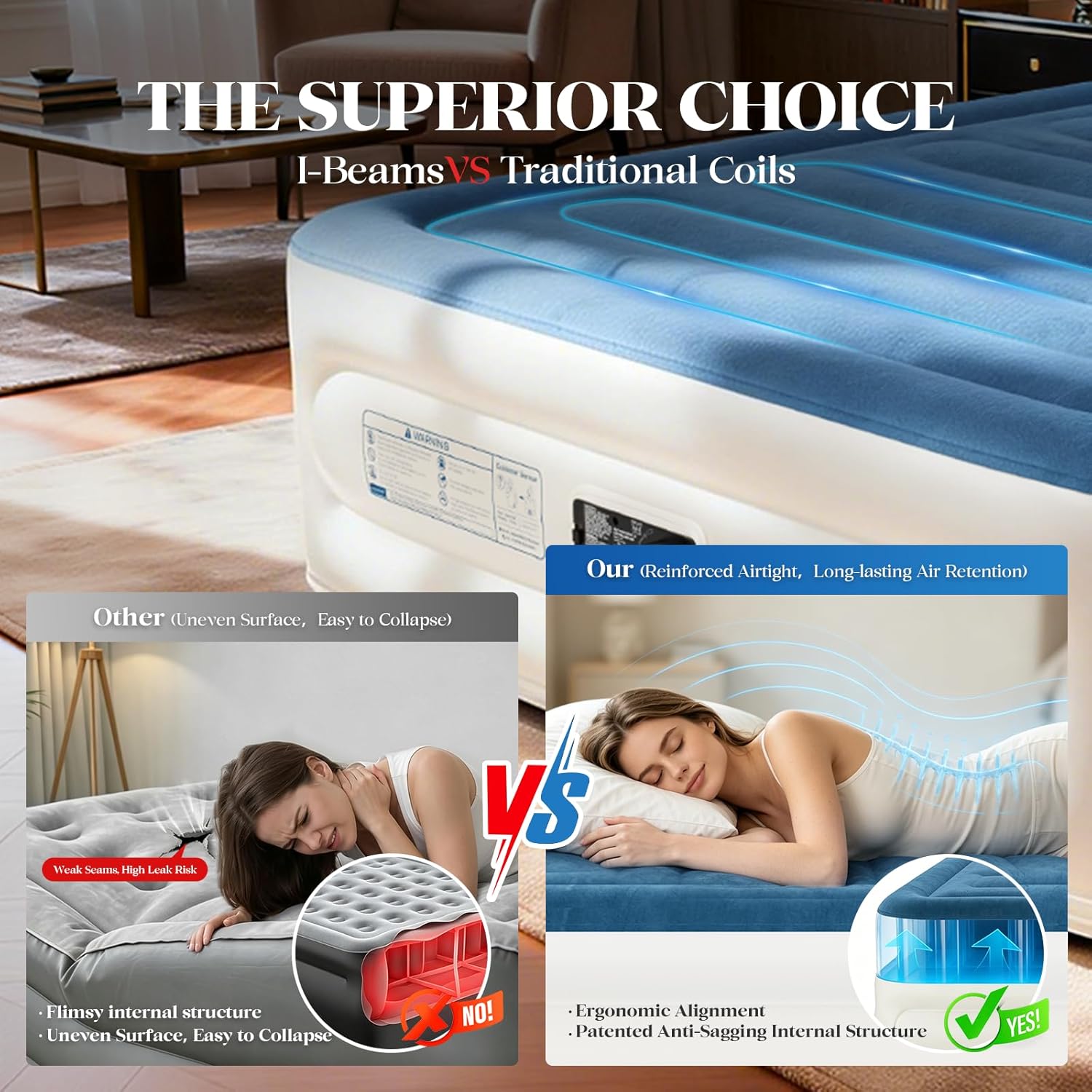
Pressure relief on an air mattress is governed largely by internal air distribution rather than foam layering, and the patented I-Beam structure in this model is specifically engineered to address the sagging and “taco effect” common in cheaper single-chamber designs. By connecting the top and bottom layers with high-tensile internal supports, the construction resists the tendency of two sleepers to roll toward the center of the bed, a common complaint with inexpensive inflatable mattresses that lack internal reinforcement. This creates a more uniform surface across the full 60-inch width, which supports more consistent spinal alignment for side-by-side sleepers rather than one partner settling into a shared depression. The result is a support system that behaves more like a coil-based mattress foundation than a simple air-filled bag, which is the core distinction this construction method is designed to deliver.

How I-Beam Coils Reduce Sagging
Traditional air beds without internal reinforcement rely on air pressure alone to hold their shape, which allows the surface to bow inward toward the center as two sleepers add weight from opposite sides. The I-Beam architecture functions as an internal skeleton, tying the top and bottom panels together at multiple points so the mattress resists this bowing and keeps the sleeping surface closer to level from edge to edge.
This matters most in the hours after initial inflation, when a non-reinforced air bed typically loses its flattest shape as body weight settles into the center. Because the coil structure is patented specifically to counter this effect, the mattress is designed to hold a more consistent profile through a full night’s use rather than requiring re-inflation partway through sleep.
Spinal Alignment for Two Adults Sharing the Bed
Because the reinforced structure spans the entire queen-size footprint, spinal alignment benefits extend to both sleepers simultaneously rather than favoring whichever side receives less weight. This is particularly relevant for couples of differing body weights, where uneven air distribution on a non-reinforced bed can otherwise pull the lighter sleeper toward the heavier one throughout the night.
The 660-pound combined weight capacity also plays a role here, since it indicates the internal structure is rated to maintain its shape under substantial combined load rather than only under the weight of a single average adult. This capacity rating suggests the alignment benefits of the I-Beam design are engineered to hold up across a wide range of body types sharing the same surface.
Temperature Regulation and Sleep Surface Comfort
Air mattresses inherently behave differently from foam or hybrid mattresses when it comes to temperature, since the interior is filled with air rather than heat-retentive foam layers. The flocked top surface on this model is intended to reduce the clammy, plastic-against-skin sensation common on unflocked vinyl air beds, while also improving traction so sheets and sleepers do not slide during the night. Because the mattress body is largely air rather than dense insulating material, it tends to feel temperature-neutral, adapting closer to ambient room temperature rather than trapping body heat the way memory foam can. This can be an advantage for warm sleepers but may also mean the surface feels cooler on chilly nights, particularly for camping or outdoor use.

Flocked Top Surface and Skin Feel
The flocked finish gives the top layer a soft, fabric-like texture rather than the slick feel typical of bare PVC. Beyond comfort, the texture helps fitted sheets and standard bedding grip the surface more securely, reducing the shifting that can otherwise occur on smooth inflatable mattresses when sleepers change positions during the night.
This surface treatment also reduces the audible squeak and friction sound often associated with vinyl air beds, since flocking creates a soft buffer between skin, sheets, and the underlying PVC shell. For guests unfamiliar with air mattresses, this can make the sleep surface feel closer to a conventional mattress cover than to bare plastic.
Airflow Behavior in Indoor and Outdoor Settings
Because the mattress is air-filled rather than foam-insulated, ambient temperature has a more direct effect on surface feel than it would with a traditional mattress. Indoors, this generally results in a neutral, breathable sleep surface, while outdoor or camping use in cooler conditions may call for additional bedding layers to offset heat loss through the air chamber.
Unlike memory foam, which can trap body heat and feel warm to sleep on, the air chamber inside this mattress does not retain heat in the same way, so warm sleepers may find it stays cooler through the night. The tradeoff is that it also provides no insulating barrier from cold air beneath the mattress, which is a relevant consideration for camping on cold ground.
Motion Isolation and Stability for Couples
Motion isolation on air mattresses typically lags behind memory foam and hybrid models, since air transmits movement more readily than viscoelastic material. However, the I-Beam internal structure on this mattress is designed to reduce the wave-like motion transfer common in basic inflatable beds by keeping the surface more rigid and evenly supported. The anti-slip bottom further contributes to stability by preventing the entire mattress from shifting on hard flooring when one partner moves or changes position, which indirectly reduces the perception of motion transfer even though the air chamber itself does not fully isolate movement the way foam does. Couples with differing sleep schedules should expect some detectable motion but a more controlled response than typical single-chamber air beds, particularly compared with entry-level inflatable models that rely on a single open air cavity.

Reduced Wave Motion from Reinforced Coils
Single-chamber air beds without internal reinforcement often produce a noticeable wave effect when one sleeper shifts position, rippling across the surface toward the other side. The connected I-Beam coils reduce this ripple by distributing air pressure more evenly across internal chambers, resulting in a more contained response to movement rather than a broad surface-wide wave.
This distribution effect is most relevant for couples with staggered sleep or wake times, since one partner getting in or out of bed is a common trigger for disturbance on basic air mattresses. While the reinforced structure narrows the zone of noticeable movement, it does not eliminate motion transfer the way a foam or hybrid mattress would, since air itself remains inherently more responsive to pressure changes than viscoelastic material.
Anti-Slip Base for Nighttime Stability
The anti-slip bottom layer keeps the mattress anchored to flooring surfaces, which matters for both stability and noise reduction. A mattress that shifts or squeaks against hardwood or tile with every movement can be as disruptive as motion transfer itself, so a grippy base contributes meaningfully to a quieter, steadier sleep surface for two adults.
This is especially relevant on the smooth, hard flooring often found in guest rooms or finished basements, where a mattress without a textured underside can creep across the room over the course of a night. Combined with the raised 18-inch height, a stable base also reduces the risk of the mattress tipping or sliding when a sleeper sits on the edge to get in or out.
Durability, Puncture Resistance, and Long-Term Support
Durability is a central selling point for this mattress, built around extra-thick PVC described as 30 percent thicker than standard air bed material along with a manufacturer-cited 7,000-cycle stress test and a 10-year support commitment. These figures suggest engineering intended for repeated inflate-deflate cycles rather than a single-season product, which matters for buyers who plan to use the mattress regularly for guests or camping trips rather than as a one-time emergency bed. The included repair patch acknowledges that punctures remain a possibility with any inflatable product, regardless of material thickness, particularly in outdoor settings with rough or uneven ground. The built-in 110V pump, rated to inflate or deflate the mattress in under three minutes, also reduces the practical burden of setup and breakdown, which is often the primary durability concern users report with manual-pump alternatives that wear out from repeated hand-pumping.
PVC Thickness and Puncture Resistance
The extra-thick PVC shell is positioned as more resistant to abrasions, pet claws, and rough flooring than standard-gauge inflatable material. While added thickness reduces the likelihood of accidental punctures, it does not eliminate the risk entirely, which is why the included repair patch and careful surface selection remain relevant considerations for outdoor or high-traffic use.
The manufacturer’s 30 percent thickness increase over standard air bed material is specifically framed around family camping trips and years of regular home use, distinguishing it from thin, single-season inflatable products. Buyers placing the mattress on rough ground or near pets should still use a groundsheet or protective layer where practical, since no PVC gauge is fully puncture-proof.
Built-In Pump Reliability Over Time
Because the pump is integrated into the mattress body rather than a separate hand-held unit, it removes a common point of failure associated with detachable pumps. The rotary dial control also simplifies operation, reducing wear from repeated manual pumping that can shorten the lifespan of budget air beds lacking an integrated motor.
Rated to inflate or deflate the full queen size in under three minutes, the 110V motor is designed for frequent use cycles rather than occasional emergency setup, aligning with the manufacturer’s cited 7,000-cycle stress test. This positions the pump mechanism as suited to households that plan to set up and break down the mattress repeatedly over multiple seasons.

Pros & Cons
Pros
- The 18-inch raised height mimics a traditional bed frame, making it noticeably easier for seniors and guests to sit down and stand up compared with low-profile air beds.
- Patented I-Beam construction reduces sagging and the “taco effect,” helping keep two sleepers supported evenly across the full width of the mattress.
- The flocked top surface improves skin comfort and helps bedding stay in place, addressing a common complaint about slippery vinyl air beds.
- A built-in 110V pump inflates or deflates the mattress in under three minutes, simplifying setup for guest rooms and camping trips alike.
- Extra-thick PVC construction and a 7,000-cycle stress rating point to a mattress engineered for repeated, long-term use rather than occasional emergencies.
- A 660-pound weight capacity accommodates two adults, supporting couples and heavier sleepers without exceeding the mattress’s rated limits.
- The anti-slip bottom reduces shifting and noise on hard flooring, contributing to a steadier, quieter sleep surface.
- A 10-year manufacturer support window and included repair patch offer reassurance for buyers concerned about long-term reliability.
Cons
- As an air-filled mattress, it lacks the deep pressure relief and body-contouring of foam or hybrid models, which may not suit side sleepers seeking more cushioning.
- Motion isolation, while improved by the I-Beam structure, still does not match memory foam, so restless partners may notice some movement transfer.
- Temperature behavior is largely neutral rather than insulating, meaning outdoor or cold-weather use may require extra bedding for warmth.
- Firmness is fixed at a generally firm baseline, and while the dial allows some adjustment, it does not offer the range of a dedicated adjustable-firmness mattress.
- Long-term daily use as a primary mattress is not the intended purpose, and buyers seeking an everyday replacement bed may find better-suited alternatives.
Final Verdict: Who This Mattress Is Best For (and Who Should Skip It)
The VOSSER Queen Air Mattress with Built-In Pump is best suited to households that need a dependable, easy-to-store sleeping surface for recurring rather than everyday use, including guest bedrooms, family camping trips, and situations where seniors or visitors benefit from an elevated, frame-like profile. Couples who prioritize stable, sag-resistant support over plush contouring will likely find the I-Beam construction and firm feel align well with back and stomach sleeping positions, while the flocked top and anti-slip base add meaningful comfort and stability compared with basic single-chamber air beds. The 660-pound capacity and reinforced PVC shell further support its positioning as a durable option for shared use rather than a single lightweight sleeper. Buyers who should look elsewhere include dedicated side sleepers wanting deep pressure relief, anyone seeking a permanent nightly mattress replacement, and those prioritizing maximum motion isolation for a restless co-sleeper. Within the broader 2026 air mattress category, this model stands out primarily for its raised height and reinforced internal structure rather than plush comfort, making it a practical match for guest-hosting and travel scenarios more than a primary bed replacement.

Frequently Asked Questions (FAQs)
How tall is the VOSSER Queen Air Mattress with Built-In Pump compared to standard air beds?
It measures 18 inches from floor to sleep surface, roughly double the height of typical low-profile inflatable beds sold for camping or emergency use. This raised, double-high design is intended to mimic the seating and standing height of a conventional bed frame, which can make entry and exit noticeably easier for seniors, overnight guests, and anyone who finds low-to-the-ground air mattresses uncomfortable or difficult to use over multiple nights.
Does the I-Beam construction really stop the mattress from sagging in the middle?
The patented I-Beam design links the top and bottom layers with internal high-tensile supports, which is intended to prevent the sinking, center-pulling effect common on basic single-chamber air beds where two sleepers gradually roll toward the middle. While no air mattress is entirely immune to gradual air settling over the course of a night, this internal reinforcement is specifically engineered to keep the sleeping surface more level and stable than unreinforced, single-cavity alternatives typically found in budget models.
Is this air mattress a good option for everyday, long-term use as a primary bed?
It is designed primarily for occasional and recurring use, such as hosting overnight guests, family camping trips, or temporary sleeping arrangements, rather than as a permanent nightly mattress replacement. The reinforced PVC shell and 10-year manufacturer support suggest reasonable durability across repeated setup and breakdown cycles, but buyers seeking a daily-use primary mattress will typically find more consistent long-term pressure relief and comfort from dedicated foam or hybrid mattress constructions instead.
How long does it take to inflate or deflate the mattress with the built-in pump?
The integrated 110V electric pump is rated to fully inflate or deflate the entire queen-size mattress in under three minutes using a single rotary dial control. This built-in motor eliminates the need for a separate hand or foot pump and significantly simplifies setup for guest rooms, family camping trips, or any scenario where quick preparation and breakdown of the sleeping surface matters.
Does the VOSSER air mattress sleep warm or cold?
Because the mattress core is filled with air rather than insulating foam, it tends to feel temperature-neutral indoors and does not trap body heat the way memory foam layers commonly do. In cold environments or when used outdoors, the surface can feel cooler to the touch. Warm sleepers may appreciate the reduced heat retention, while outdoor or cold-weather campers may want additional bedding layers underneath for extra insulation.
How much weight can the VOSSER Queen Air Mattress support?
The mattress carries a manufacturer-listed weight capacity of 660 pounds, which accounts for two adults sharing the surface simultaneously rather than a single lightweight user. This capacity, combined with the reinforced I-Beam internal structure, is intended to keep the mattress stable, level, and evenly supported under substantial combined loads rather than only under the weight of one sleeper on one side.
What happens if the air mattress develops a leak?
The mattress ships with an included repair patch kit designed to address small punctures without requiring replacement of the entire unit. The extra-thick PVC construction, listed as 30 percent thicker than standard air bed material, is intended to reduce the likelihood of leaks from everyday abrasions, pet claws, or rough flooring, though outdoor and high-traffic use still carries some inherent puncture risk common to all inflatable products.
Is the flocked top surface removable or machine washable?
The flocked top is bonded directly to the mattress body rather than functioning as a separate, removable cover, so it is not designed for machine washing on its own. Standard fitted sheets can be used over the surface for hygiene and easier cleaning between uses, and the flocked texture also helps bedding grip the mattress more securely, reducing shifting compared with bare vinyl surfaces.